Ceramic Composition Resistors(RMC)
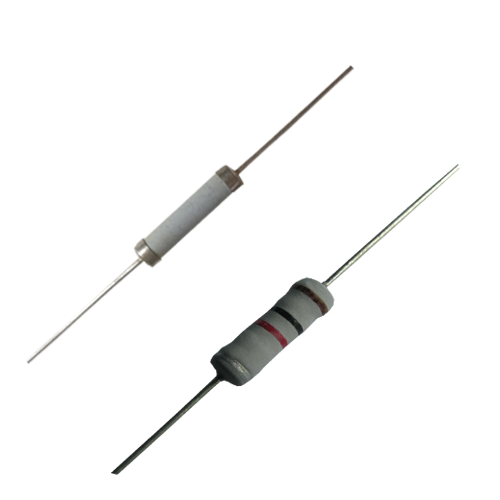
Ceramic Composition Resistor (RMC Series)
- Non-inductive pulse resistor
- Rated power: 0.5W, 1W, 2W
- Maximum pulse energy: 30J-80J
- Tolerance: ±10% or ±20%
- Product description: RMC ceramic composition resistors provide non-inductive pulse handling up to 80 J in 0.5 W, 1 W and 2 W ratings for radar, snubbers, drives and dummy loads.
JDC RMC ceramic composition resistors are non-inductive bulk ceramic resistors designed for pulse, surge, and high-energy applications. A blended clay, alumina, and ceramic resistive core is molded inside an insulating body to provide stable pulse handling without a wound element.
Why use a ceramic composition resistor?
- Non-inductive construction for fast pulses and high-frequency circuits.
- High peak-power and pulse-energy capability in a compact axial package.
- No wire element that can disconnect during severe surge conditions.
- Useful as a modern replacement for carbon composition resistor arrays.
- Custom sizes, surface-mount formats, and special footprints can be evaluated.
RMC series specifications
| Rated power | 0.5 W, 1 W, and 2 W |
|---|---|
| Maximum pulse energy | 30 J (0.5 W), 50 J (1 W), and 80 J (2 W) |
| Resistance tolerance | K: ±10%; M: ±20% |
| Construction | Bulk ceramic, non-inductive |
| Termination option | Lead-free terminations that meet EU RoHS requirements |
Typical applications
RMC ceramic composition resistors are used in radar systems, broadcast transmitters, motor drives, semiconductor processing equipment, medical defibrillators, RF amplifiers, X-ray and laser equipment, soft-start and current-limiting circuits, snubbers, dynamic braking circuits, dummy loads, and power-conditioning equipment.
Specification and engineering support
Download the RMC ceramic composition resistor specification for detailed selection data. For a pulse-energy requirement or custom footprint, send an engineering inquiry.
Related Products

Categories
- Wirewound Power Resistors
- Shunt Resistors
- Blower Motor Resistors
- Current Sensing Resistors
- Dynamic braking resistor
- Composition Resistors
- Water Cooled Resistor
- Ceramic Encased Resistor
- Crowbar Resistor
- Load Bank
- Neutral Grounding Resistor
- Thick Film Resistor
- Rheostats
- Film Resistors
- High Voltage Resistors
- LED Autolamps Load Resistors
- Resistor Network
- Potentiometer
Latest News
Contact Us
Contact: Tom Tan
Phone: (86)-15602914508
Tel: (86)-755-28158718
Email: tom@jdcresistors.com
Add: 1st Floor, GUOYAO Industry Park, HUANGJIANG Town, DONGGUAN, GUANGDONG, China
 Sales Team